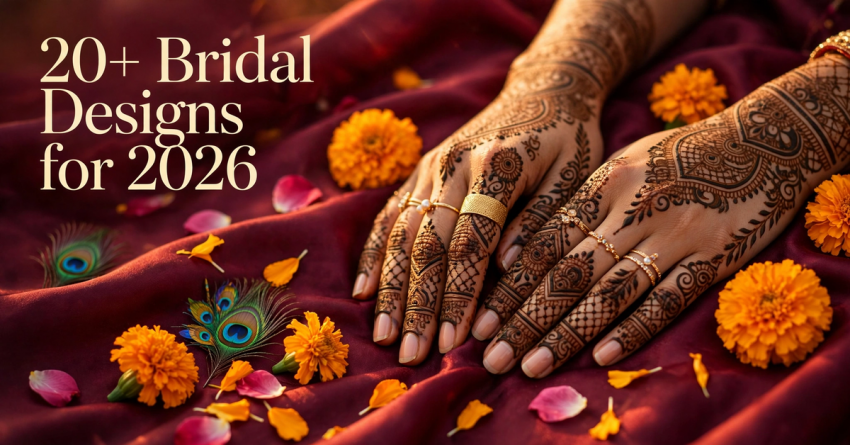
Ask any recently married woman in Delhi NCR what she remembers most vividly from her wedding morning, and somewhere between the hair pulling and the last-minute jewellery panic, she will mention her mehandi. Not just that she wore it, but how it looked, how dark it turned, and how many aunties asked where she got it done. Choosing the best mehandi designs for brides is genuinely one of the most personal decisions in wedding planning, because unlike the lehenga you wear for six hours, your mehandi stays with you for two weeks and shows up in every single close-up photograph.
The good news is that 2026 brides have more choice than any generation before them. The old rule was simple: full hands, full forearms, darkest possible. Today’s brides mix that tradition with styles their mothers would never have imagined — negative space, fingertip-only designs, even portraits of the couple woven into the pattern.
Traditional Styles That Refuse to Retire
Some designs survive because they photograph beautifully and carry meaning. The classic dulhan doli — the bride’s palanquin with the groom’s procession — remains the most requested bridal motif in North India, and for good reason. It tells the story of the wedding itself, right there on your palm. Close behind it is the raja-rani pair, the royal couple rendered in fine lines, usually framed by an arch of paisleys on the back of the hand.
Then there is the jaimala scene, the couple exchanging garlands, which has become enormously popular for the palm centre. For brides who want full, dense coverage, the traditional full paisley jaal is still unmatched: interlocking mango-shaped paisleys filled with fine dot work, running from fingertips to elbow. It takes hours to apply, but the stain it leaves is deep and even because the paste sits thick.
The peacock trail is another evergreen — a peacock feather unfurling from the wrist up the forearm, its “eyes” detailed in concentric dots. Pair it with the lotus bandh, a band of lotus flowers circling the wrist, and you have a combination that works beautifully with red and maroon lehengas. For the feet, the bridal foot jaal — a delicate net of paisleys and dots — completes the traditional look.
Best Mehandi Designs for Brides: The Modern Favourites of 2026
Now for what is new. Minimal fingertip mehandi — where only the fingertips and the top phalanges carry dense design, fading into bare skin — has gone from niche to mainstream. It suits brides wearing heavy rings and bracelets, since the jewellery becomes part of the design. The best mehandi designs for brides in 2026 are not all about coverage; many are about placement.
The Arabic diagonal trail remains a favourite for sangeet and engagement: a bold vine of roses and leaves sweeping from the index finger across the back of the hand to the wrist, with the rest of the hand left clean. It applies fast, stains well, and looks striking in photographs. Its cousin, the rose trail, uses the same diagonal flow but with fully shaded roses that give a 3D effect.
Negative-space mandala designs are the thinking bride’s choice. A large mandala sits in the palm centre, radiating outward in geometric bands that deliberately leave skin showing between the lines — the contrast makes the stained portions look darker. Portrait mehandi takes personalisation further: the couple’s faces, or meaningful elements like the wedding venue, drawn into the forearm panel. It needs a genuinely skilled artist, so book early and ask to see previous portrait work.
Two accent styles deserve mention. White henna creates lace-like patterns popular for receptions, though it lasts only a day or two. Glitter mehandi adds sparkle over a henna base and is a sangeet-night favourite. The bracelet or bangle style, where the design mimics stacked bangles around the wrist, is elegant for brides who prefer subtlety. And the half-moon backhand — a crescent of dense jaali work across the knuckles — photographs wonderfully when you are holding your bouquet.
Finally, the jaali wrist cuff: a band of fine lattice from wrist to mid-forearm, often combined with the hathphool or ring-chain design, where a chain of dots connects a ring motif on the finger to the wrist band. The geometric band style — clean lines, chevrons, and dots in symmetrical rows — suits brides with modern, structured outfits. A good artist will happily blend these families: a traditional palm with a modern cuff, or an Arabic trail on one hand and full bridal on the other.
Match the Design to the Function
Here is where brides go wrong most often: picking one design for everything. Your wedding is four or five different events, and your mehandi should change with them. For haldi, keep it simple — a light floral trail or mandala palm that will not clash with the turmeric and marigolds.
Sangeet is where you play. This is the night for glitter mehandi, white henna accents, or the Arabic trail — designs that catch light and look dramatic in dance-floor photos.
The wedding day itself deserves the full bridal treatment: dense, traditional, extending well past the wrist. This is the mehandi that appears in your pheras photographs and stays through the vidaai. When shortlisting the best mehandi designs for brides, reserve your most detailed work for this day. Apply it two days before the wedding — the stain needs 24 to 48 hours to reach its deepest colour, and wedding-morning application is a recipe for smudging against your outfit.
For the reception or cocktail, consider the feet and any visible skin the earlier designs left bare. A delicate foot jaal or ankle vine works beautifully with heels.
Getting That Deep, Dark Stain Everyone Asks About
Let us be honest: the design gets the compliments on day one, but the colour gets them on day three. A deep, near-black stain is mostly about aftercare, not the paste. The single most important rule is time — keep the paste on for at least six to eight hours, overnight if you can manage it.
Before application, wash your hands well and skip moisturisers; clean, slightly dry skin takes the dye better. During drying, a lemon-sugar seal dabbed gently over the design keeps the paste moist and stuck to the skin longer, which deepens the stain. Once the paste starts flaking, do not wash it off with water — scrape it off with a spoon back or an old card, and avoid water on the area for the next several hours.
After removal, warmth is your friend. Apply a natural oil like coconut or mustard oil before any water contact for the first day or two; it seals the stain in. Skip swimming pools, harsh soaps, and exfoliating scrubs for a week. The stain will deepen over 24 to 48 hours, going from bright orange to rich brown, and a well-cared-for bridal stain stays beautiful for ten days to two weeks.
Choosing the Artist Who Applies It
A great design in the wrong hands is just a smudge, so choosing the artist matters as much as choosing the design. Start by looking at real photographs of their work — not stock images, but actual brides, with close-ups you can zoom into. Fine lines should be crisp and dots even. If an artist only shows one style, that is the only style you will get.
Ask the practical questions early. How long does a full bridal set take them? Do they do a trial for detailed work like portraits? Do they come to your home or venue — critical, since you cannot travel across Delhi NCR with wet mehandi. What paste do they use? Fresh, natural henna paste gives the safest, darkest stain; be wary of anything promising instant black colour.
Book early. The wedding season in Delhi NCR — roughly October through February, plus the summer wedding window — fills good artists’ calendars weeks ahead. Show your artist reference photos, tell them what you love and what you do not, and let them sketch a plan. The best bridal mehandi is always a collaboration.
Frequently Asked Questions
How far in advance should a bride apply mehandi?
Two days before the wedding is ideal. The stain needs 24 to 48 hours to darken fully, so applying two days prior means peak colour on the wedding day itself. Applying on the wedding morning risks smudging and leaves you with an orange stain in your pheras photos.
Which mehandi design lasts the longest?
Longevity depends more on aftercare and paste quality than on the design. Dense traditional designs with thick paste coverage tend to stain darkest and last longest — often up to two weeks with good care.
Can I mix traditional and modern styles?
Absolutely, and most 2026 brides do. A common combination is a traditional dense palm with a modern geometric cuff on the forearm, or full bridal on the wedding-day hand with an Arabic trail style for sangeet. Discuss the blend with your artist so the two styles flow into each other rather than clashing.
Is portrait mehandi worth it?
If personalisation matters to you, yes — but only with an artist who has a proven portfolio of portrait work. Ask to see close-up photos of faces they have drawn before. Done well, it is the most talked-about element of your bridal look; done badly, it is very hard to fix.
How do I keep the colour dark for the reception too?
Follow the aftercare strictly: keep paste on overnight, scrape rather than wash, oil the skin before water contact, and avoid exfoliation. Brides who follow the full routine usually still have rich colour a week later, well past the reception.
Should the groom get mehandi as well?
Many grooms now get a small motif — initials, the wedding date, or a simple band — and it makes for lovely couple photographs. It takes ten minutes and has become a sweet tradition in many Delhi NCR weddings.
Your Hands Deserve an Artist Who Gets It
Twenty-plus styles, five functions, one pair of hands — choosing bridal mehandi can feel overwhelming, but it does not have to be. Start with what makes you happy, match it to your functions, book an artist whose portfolio you trust, and give the stain the time it needs.
Shagun Mehandi Arts specialises in bridal mehandi across Delhi NCR, from classic dulhan motifs to the modern styles 2026 brides are asking for — with home service so you never have to travel with wet paste. Browse the best mehandi designs for brides in the portfolio and lock your wedding date early in the season rush. Your hands are going to be in every photograph. Make them unforgettable.